
In a Sense Books examines the nature of existence through a consciousness-only model. This approach challenges materialist assumptions, shifting philosophical inquiry from how physical matter generates conscious experience to how the undeniable reality of knowing assumes form and a localized perspective.
The following book sample addresses classical theological questions using nondual ontology. By reframing conventional paradoxes, doctrinal tensions, and metaphysical inquiries, this paradigm situates traditional religious concepts within a unified model, providing a coherent basis for understanding foundational topics such as suffering, free will, and the essence of ultimate reality.
From Indivisible: Classical Theology in a Nondual Reality, Volume I
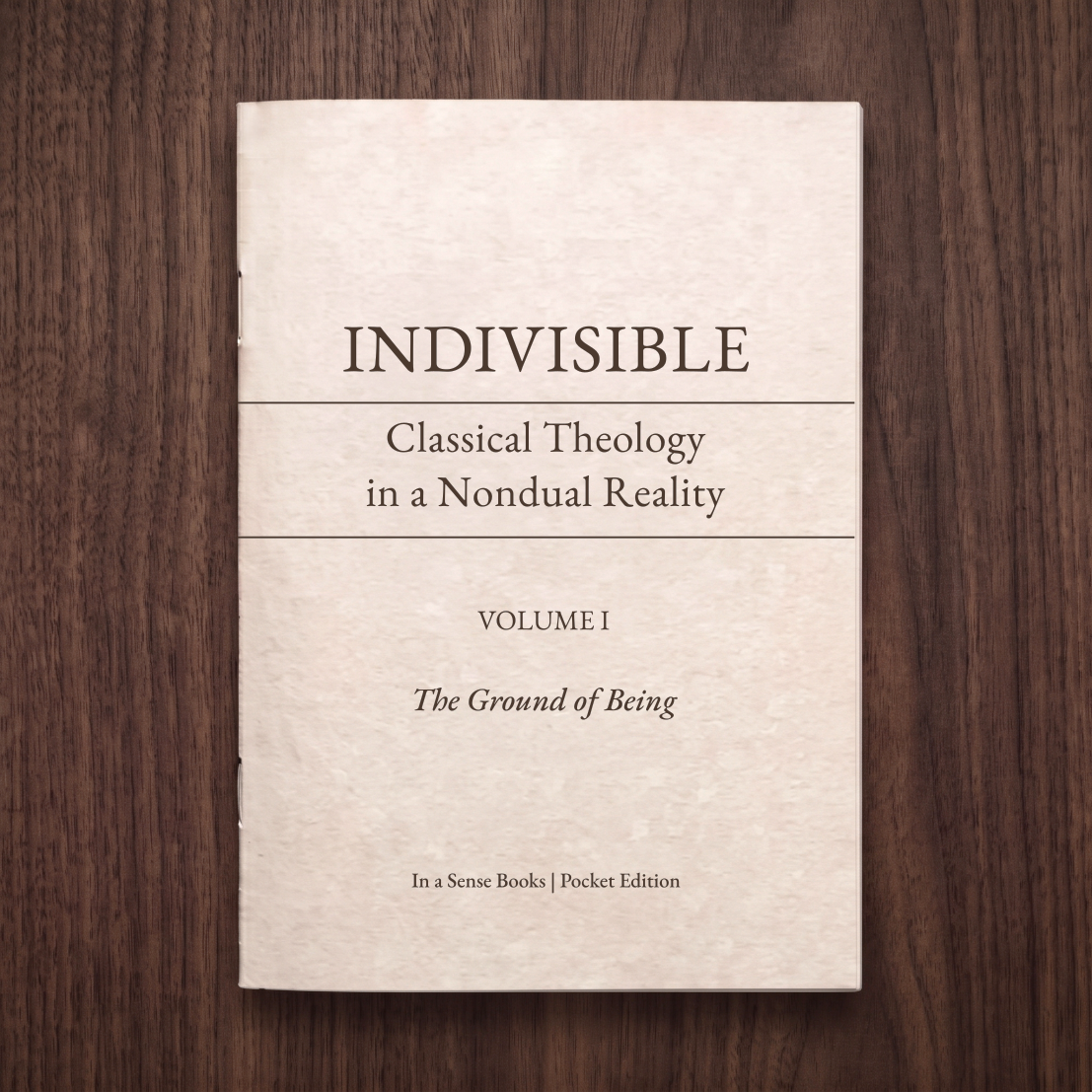
What is the exact nature of the divine?
The absolute is the singular reality of pure knowing, an inherent, dynamic capacity for manifestation. This foundational reality is both the silent, observing presence of all experience and the activity that constitutes the physical universe.
What is the origin of creation?
Mainstream traditions often depict creation as an event where a separate deity constructs the universe out of nothing. This concept inherently relies on a fundamental separation between the creator and the created. Viewed through a nondual framework, however, there is no external material to build with; instead, creation represents the spontaneous manifestation of pure awareness assuming specific, localized expression. The physical universe is not a separate artifact but a dynamic, ongoing emanation in consciousness, made of consciousness, and known by consciousness.
What is the ultimate purpose of human existence?
Dogmatic frameworks generally assign existence an external teleological goal, such as earning salvation or passing a moral test. From a nondual perspective, absolute consciousness spontaneously manifests as specific, localized forms. This finitude is not a restriction, but a creative emanation. The localized perspective provides the specific vantage point through which foundational awareness moves from self-concealment to self-recognition.
How does God interact with the physical universe?
Fundamental reality does not relate to the universe as a separate, external force. Instead, the tangible, substantial experience of the physical world is an ongoing process of emanation, formed entirely of the activity of consciousness. A seemingly solid object, such as a tree, is not ultimately composed of physical matter; rather, the object itself is a direct modulation of knowing. This framework does not deny the observable reality of wood or cellulose, but instead questions the unexamined materialist assumption that these components are made of mind-independent stuff. However, this does not mean the object requires a human observer; even in the absence of a first-person perspective, the object remains a spontaneous, fully formed, and stable manifestation of universal consciousness prior to localized perception.
If God is good and all-powerful, why does evil exist?
What is traditionally conceived of as a distant creator is understood here as nondual consciousness—a birthless, deathless, indivisible reality of knowing manifesting as seemingly separate, finite forms. The absolute does not use these forms as a lens to view a separate universe. Instead, the localized perspective is the direct emanation of the absolute. As this singular reality interacts with itself across countless limited perspectives, struggle and strife naturally occur. Challenges are not flaws in a created world, but rather the inevitable friction of consciousness knowing itself from different points of view. This perceived separation creates the convincing illusion of fundamental boundaries, from which stems the selfish action and conflict known as evil.
What is the nature of the human soul?
Mainstream traditions routinely describe the soul as an independent, enduring entity created by, yet forever separate from, a supreme deity. Within nondual frameworks, the soul functions as a localized, first-person perspective through which absolute consciousness experiences limitation and individuality. The soul remains essentially identical to the universal absolute, acting as a specific focal point within a unified field of knowing. When the physical body ends, localized awareness may persist through subtle conditioning, but the essence of the soul is never anything other than indivisible awareness knowing itself from a specific vantage point.
What constitutes divine revelation?
Conventional doctrine often treats scripture and prophecy as external dictates handed down across a spatial gap from heaven to earth. Yet, if reality is a single, continuous field of knowing, there is no distance for a message to cross. Revelation occurs as the direct emergence of undivided awareness recognizing itself through a specific localized perspective. Spiritual insights represent the natural capacity of consciousness to illuminate its own true nature from within the boundaries of a human form.
Is salvation exclusive to one religion?
Although traditionally framed as a rescue from external condemnation, salvation is simply the recognition of the mind’s fundamental inseparability from nondual consciousness, a realization available to any localized viewpoint regardless of cultural or religious background. While formal doctrines often harden into a dualistic ideology, the contemplative practices within these traditions function to focus attention back upon the indivisible reality of knowing.
Does humanity have free will, or is the future predetermined?
Nondual consciousness is absolute, unconditioned freedom. Because every finite form is a manifestation of this consciousness, that foundational freedom is ever-present. Prior to this recognition, the localized perspective is governed by conditioning, a state where deeply ingrained patterns translate into binding fate. True free will emerges only when the localized perspective recognizes its identity as pure awareness.
What happens after death?
Physical death represents the dissolution of a specific biological localization, but not the end of the awareness knowing itself as that form. When identification with separation persists, awareness continues its emanation through subtle domains structured by prior conditioning until those contractions are exhausted. Upon full recognition of its true nature, awareness rests as itself, free and unconditioned.
Indivisible: The Complete 12-Volume Collection
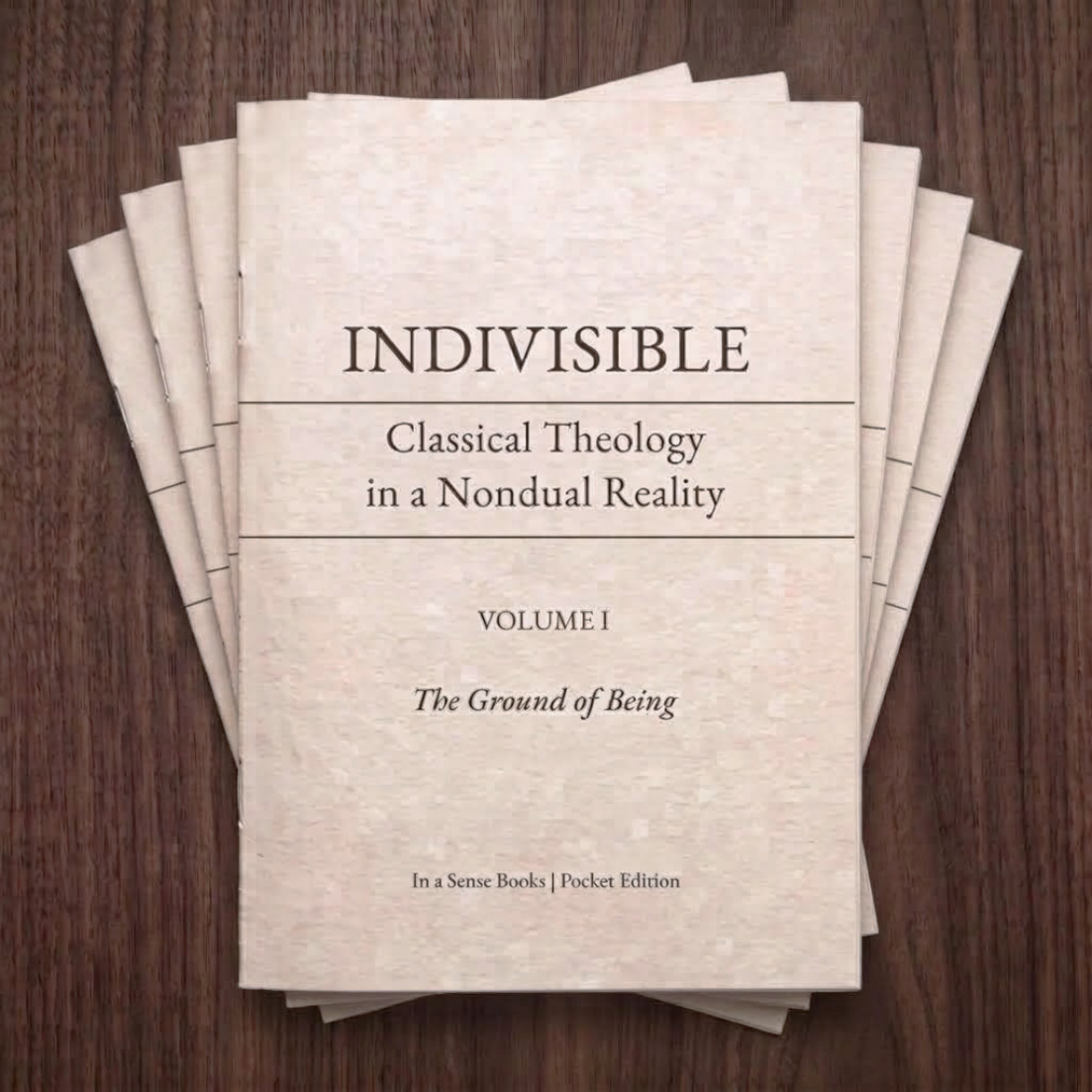
Why 12 Volumes? There is a deliberate irony in dividing a work titled Indivisible into 12 separate parts. But intellectual understanding rarely survives a lifetime of cultural conditioning. The philosophy of nonduality must be investigated from multiple angles until the concept clarifies into recognition. The physical separation of these booklets serves that purpose: twelve different doorways opening into the exact same room.
Volume I: The Ground of Being
Volume II: The Localized Perspective
Volume III: Cosmology and the Subtle Domains
Volume IV: The Structures of Belief
Volume V: Mythological Expressions of Separation
Volume VI: Resolving Orthodox Doctrine
Volume VII: The Function of Sacred Practice
Volume VIII: Relational Theology and the Material World
Volume IX: Fate, Redemption, and the Problem of Suffering
Volume X: The Internal Landscape and Spiritual Affliction
Volume XI: Apocalyptic and Esoteric Symbols
Volume XII: Ultimate Realization and the Absolute
Further Explorations
The Q&A pages apply the nondual paradigm to an even broader spectrum of inquiry, exploring subjects ranging from artificial intelligence and consciousness to the human desire for material wealth.