
The following commentaries examine contemporary art and culture through the lens of ontological idealism.
Mapping the Non-Spatial: A Tantric Response to Contemporary Theories of Consciousness
Robert Lawrence Kuhn and Alex O’Connor discuss Kuhn’s Landscape of Consciousness project in the video, Every Theory of Consciousness, which catalogs hundreds of theories about the nature of mind. The conversation heavily emphasizes materialism, debates the nuances between panpsychism and idealism, and touches upon the validity of altered states. In Tantric Shaivism, also known as non-dual Kashmiri Shaivism, reality consists entirely of consciousness and the inherent capacity for physical manifestation. Evaluating this interview through such a philosophical framework reveals several points of divergence.
Kuhn notes that roughly half of all contemporary theories of consciousness cataloged in his project are materialistic. The video devotes substantial time to discussing how consciousness might arise from brain states or physical processes. Tantric Shaivism approaches this from the opposite direction. Consciousness is not viewed as a byproduct of physical forms. Rather, physical forms are understood as contracted states of consciousness. The physical universe is a real, tangible manifestation of awareness expressing itself dynamically. Searching for the origin of consciousness within physical matter is fundamentally misdirected according to this tradition, as matter is simply consciousness existing at a denser frequency.
The conversation draws a distinction between panpsychism, where the physical world and consciousness share equal reality, and idealism, where the physical world is derivative or an illusion. Tantric Shaivism resists this categorization. The tradition posits that the world is entirely real exactly because it is made of consciousness. Matter is not an illusion, nor is matter separate from consciousness.
Kuhn’s project aims to categorize over four hundred theories into a comprehensive framework. While Tantric Shaivism possesses its own complex categorical system of reality, the tradition asserts that intellectual categorization cannot capture ultimate truth. The video focuses heavily on conceptual distinctions and logical boundaries. In contrast, the Tantric approach emphasizes direct experience and recognizes that dividing reality into competing intellectual models is simply a conceptual game played within the unified field of awareness. Mental constructs can guide the intellect, but liberation requires moving beyond theoretical frameworks into direct recognition of one’s own nature.
During the interview, Kuhn expresses skepticism about the ontological value of psychedelics or altered states of consciousness, viewing them as neurological anomalies rather than windows into reality. Tantric Shaivism values direct, expanded states of perception as the primary means of recognizing the true nature of consciousness. Ordinary, waking perception is considered a contracted state. Practices or experiences that expand perception may be seen as returning to a baseline of boundless awareness. From a Tantric perspective, dismissing these states limits the understanding of consciousness to its most contracted, ordinary form. ●
Cosmic Dream or Divine Manifestation: A Tantric Review of Autobiography of a Yogi
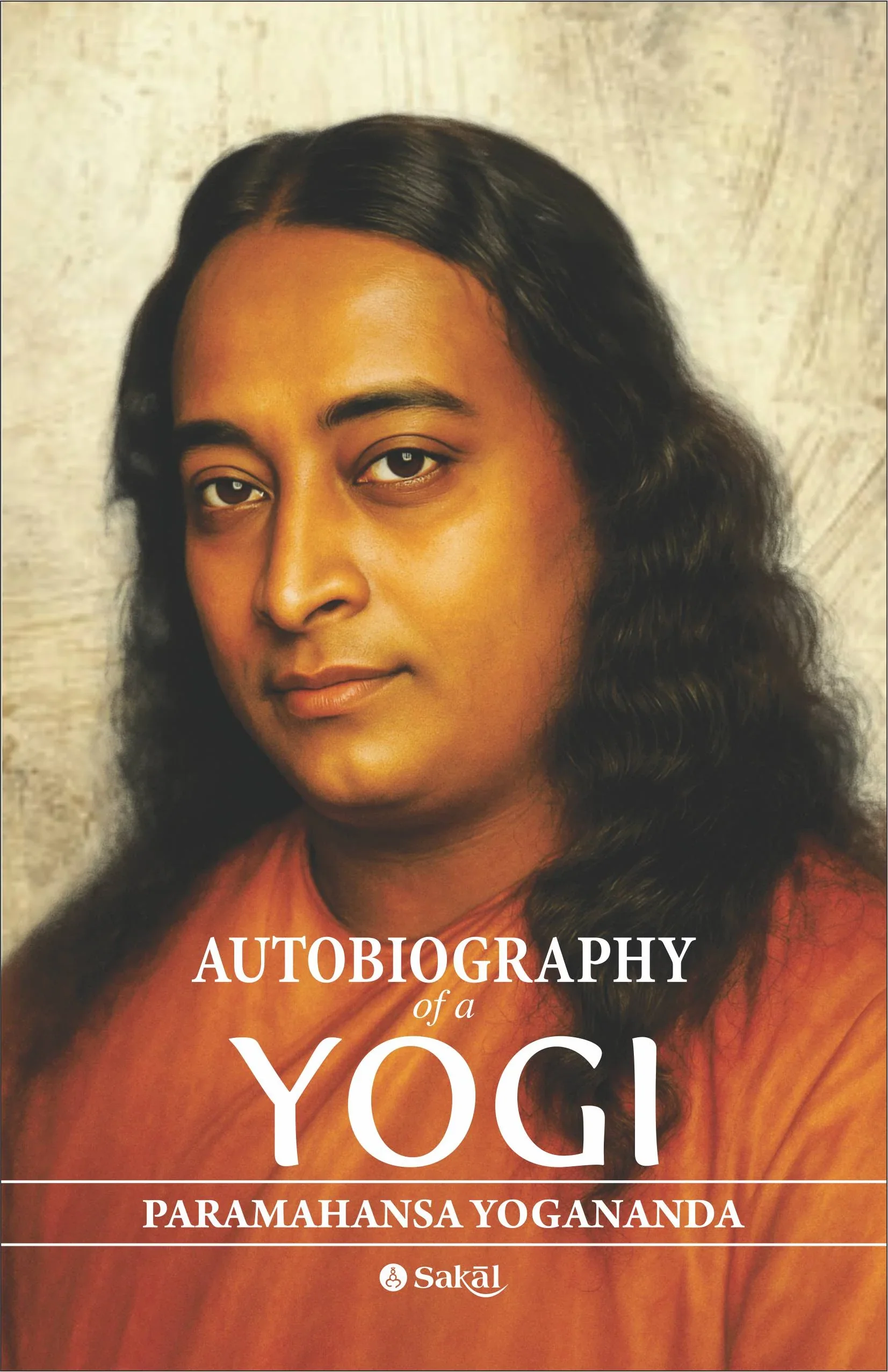
Paramahansa Yogananda’s Autobiography of a Yogi stands as a seminal text in the global transmission of Eastern spirituality, and the work shares a foundational commitment to non-dual realization with the Tantric wisdom tradition. Yogananda’s descriptions of cosmic consciousness closely resemble the Tantric experience of the unified field. However, while both systems ultimately point toward supreme awareness, their paths diverge sharply based on how each tradition interprets the nature of physical reality.
This separation begins with the ontological status of the physical universe. Throughout the book, the physical world is repeatedly characterized as a cosmic cinematic illusion from which the practitioner must ultimately awaken. The Tantric tradition firmly rejects the concept of a simulated reality. The philosophy posits that the universe is the entirely real, intentional expression of supreme consciousness. Rather than a dream to escape, the physical world is recognized as the spontaneous manifestation of the divine source.
Differing views on reality naturally lead to differing methodologies. Yogananda advocates for a highly structured system designed to withdraw life force from the senses and direct energy upward toward the brain. This methodology aligns closely with classical ascetic models that prioritize internal withdrawal. The Tantric system operates on the principle of spontaneous spiritual recognition. While specific practices are utilized, the ultimate goal does not require disconnecting from sensory input. A practitioner aims to recognize supreme consciousness precisely through sensory experience, using the external world as a direct vehicle for realization.
The autobiography places ultimate spiritual value on a trance state where awareness disconnects entirely from the physical body. The Tantric framework recognizes this withdrawn state but categorizes such an experience as an incomplete realization. The pinnacle of Tantric realization is uninterrupted wholeness, a state where the practitioner remains fully engaged with the physical world. In this highest state, external activity and internal stillness are perfectly integrated, and every object is experienced as a continuous extension of absolute consciousness. ●
Psychology and Ontology: The Limits of Jungian Integration
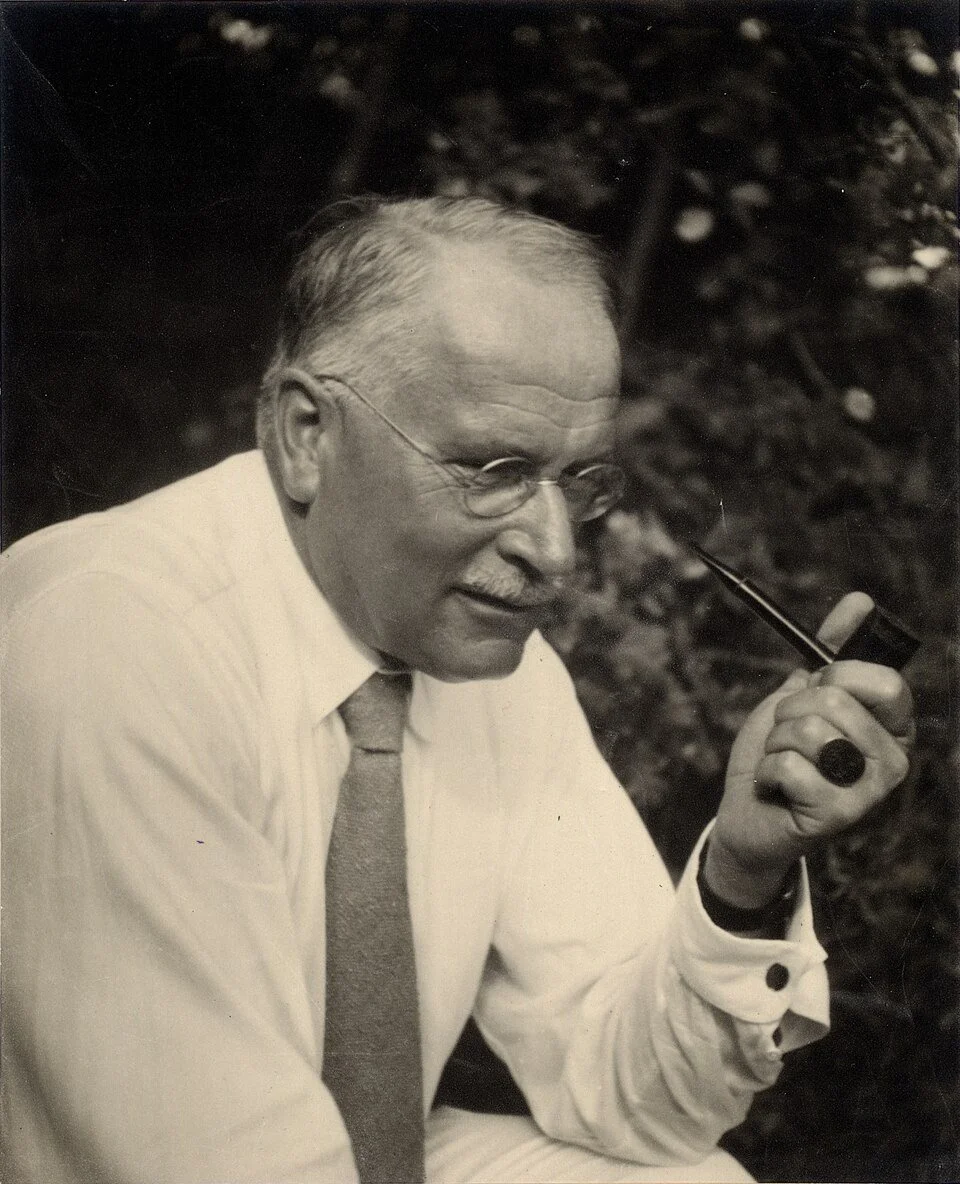
Carl Gustav Jung, c. 1935
Carl Jung’s analytical psychology and non-dual frameworks such as Tantric philosophy both explore the depths of human cognition and the relationship between the localized ego and a broader unifying reality. While emerging from vastly different disciplines and eras, these two systems share compelling structural parallels, particularly regarding the decentering of the ego and the integration of the unconscious. Furthermore, Jung extensively studied and wrote commentaries on Eastern philosophies, including yoga and alchemy, indicating that these psychological concepts did not develop in complete isolation from Eastern ontological frameworks. However, fundamental ontological differences remain.
Jung proposed the concept of the self as the central, unifying archetype of the psyche, distinct from the localized ego. The ego acts merely as the center of conscious awareness, while the underlying self encompasses both conscious and unconscious domains. In a consciousness-only ontology, the localized mind is a contracted expression of fundamental awareness. Both frameworks recognize that the true center of identity is not the personal, biographical ego, but an unconditioned, ultimate ground of being.
Jung posited the collective unconscious as a deep psychological stratum shared by all human beings, populated by archetypal patterns. The consciousness-only model expands this concept beyond psychology into ontology. In this framework, the entire manifest world is a projection of unconditioned knowing. The collective substrate is not merely psychological; this foundational awareness serves as the fabric of both mind and matter. Both systems point to a layer of reality where individual separation dissolves.
Individuation and Synchronicity
The psychological process of individuation in Jungian theory involves integrating the contents of the unconscious, including the shadow, into conscious awareness to realize psychological wholeness. A consciousness-only ontology outlines a path of direct recognition, wherein the individual recognizes localized existence as fundamentally identical to the supreme ground of being. While individuation focuses on psychological integration, recognition focuses on ontological liberation.
Jung introduced synchronicity to describe meaningful coincidences where internal psychological states mirror external physical events without a direct causal link, hinting at an underlying unity. The consciousness-only model explains this interconnectedness through the fundamental nature of reality. Because the inner psychological world and the outer physical environment are simply different densities of the same self-aware medium, correspondence between mind and matter is a natural expression of a singular, dynamic field.
Despite these alignments, a crucial distinction exists regarding the ultimate nature of reality. Jung operated primarily as an empiricist and psychologist. His early framework maps the phenomenology of the psyche, intentionally remaining agnostic about whether the archetypal self equates to an objective cosmic reality. A consciousness-only framework asserts unequivocally that pure awareness is the absolute ground of all existence, generating both the psychological subject and the physical object through an inherent creative capacity. Jung’s early model explores the tension of opposites within the mind, whereas the consciousness-only framework views all apparent polarities as the unconditioned spontaneity of an already whole subjectivity.
The Unus Mundus and the Non-Dual Substrate
Jung’s later collaborations with physicist Wolfgang Pauli pushed analytical psychology beyond the boundaries of pure empiricism. Together, the two thinkers hypothesized the unus mundus, a unitary background reality from which both the psychological subject and the physical object emerge. In this late-stage model, synchronicity is not merely a psychological projection but a momentary revelation of an underlying, undivided substance. This conceptual leap approaches the precise territory mapped by the non-dual tradition.
While Jung and Pauli theorized a unified psychophysical background, the two thinkers largely treated this domain as a neutral, unknowable limit of human inquiry. In the consciousness-only framework, the foundational reality is not a neutral void or a theoretical postulate, but pure, foundational awareness. Both frameworks point to a singular fabric of existence, yet the non-dual tradition provides a systematic ontology detailing how unified awareness actively becomes the multiplicity of experience.
Mapping Ontology Through Fundamental Awareness
The consciousness-only model is exhaustively detailed through dual principles: the foundational reality of awareness, serving as the static ground of being that makes all experience possible, and the dynamic, self-reflexive capacity of that awareness, which is the inherent power to know itself and to manifest as the myriad forms of the universe.
Within this system, the localized ego and the physical world are not illusions. The material world is the condensation of fundamental awareness. Non-dual philosophy explains the existence of the individual mind through the concept of contraction, a process where infinite awareness voluntarily limits its own capacities to experience localized existence. Supreme consciousness restricts boundless knowledge to become a specific, finite observer. Omnipotence contracts to exist within linear time, and omnipresence is localized to occupy a specific spatial location. These self-imposed limitations generate the persistent boundary between an individual subject and an external object. The Jungian project of integrating the unconscious is paralleled by the process of expanding this contracted state back into the recognition of universal nature. The psychological integration of shadow material is subsumed within a broader ontological recognition, where the localized subject realizes identity with the absolute ground.
Bridging Philosophical Vocabularies
Western philosophy and Tantric philosophy offer two distinct but highly compatible vocabularies for illuminating the same fundamental reality. Western analytical traditions utilize concepts like ontology, epistemology, and phenomenology to categorize the nature of being, the limits of knowledge, and the structure of conscious experience. The non-dual tradition uses different language for these exact domains. Where Western philosophy might debate the mind-body problem or the ontological status of the physical world, the consciousness-only model offers a systematic categorization of reality descending from unconditioned consciousness down to dense physical matter. This categorization functions as a phenomenological map, detailing how pure subjectivity thickens into objective reality.
Similarly, Western phenomenological inquiry into the relationship between the observer and the observed finds a direct parallel in the non-dual explanation of a singular, dynamic field. This shared focus highlights how both traditions attempt to resolve the tension between the localized subject and the totality of existence, echoing the earlier implications of synchronicity and the unus mundus. Western philosophy tends to rely on rigorous conceptual analysis to bridge the inner and outer worlds, while the non-dual framework integrates logical analysis with direct contemplative realization to dissolve the boundary entirely. Ultimately, both vocabularies point toward the same unified reality, demonstrating that the structural dynamics of consciousness can be apprehended through both rigorous Western logic and precise metaphysical mapping. ●
Schopenhauer, Nietzsche, and the Consciousness-Only Model of Reality
The philosophical relationship between Arthur Schopenhauer and Friedrich Nietzsche rests on several foundational agreements regarding the nature of existence. Both thinkers rejected the prevailing idea that history and the universe are inherently rational or purposeful. Instead, both philosophers argued that the human intellect is merely a biological tool serving a deeper, blind, and striving force. Consequently, both men concluded that suffering is woven directly into the fabric of existence. While these Western thinkers share a paradigm rooted in foundational lack and physiological drives, the consciousness-only model of reality posits that existence is an autonomous manifestation of pure subjectivity.
For Schopenhauer and Nietzsche, struggle and deficit are inescapable conditions of reality. Schopenhauer posits that a blind, irrational will—a fundamental, primal drive for survival and reproduction—forms the foundation of all existence. This framework assumes the fundamental nature of reality is inherently lacking and driven by endless need. Nietzsche builds upon this foundation, asserting that the physical body is the primary reality and the conscious intellect is simply a late-evolving biological tool. This perspective reduces awareness to a byproduct of physiological drives. Furthermore, both philosophers root human suffering in the inescapable chain of cause and effect. Schopenhauer concludes that existence is a mistake and advocates for ascetic renunciation to escape the suffering. Nietzsche demands a radical affirmation of life, utilizing the concept of eternal recurrence to will the return of every past event, embracing suffering as the necessary resistance for growth.
A consciousness-only model of reality fundamentally inverts this biological and deficit-driven perspective. This framework asserts that universal, unconditioned consciousness is the singular source of all existence. Unlike dualistic systems that separate the observer from the observed, the non-dual framework views the entire spectrum of reality—from the most subtle cognitive faculties to the densest physical matter—as a spontaneous and dynamic modulation of a timeless, dimensionless, and limitless source. Manifestation is not viewed as a flaw to be escaped, but as a direct expression of pure, unconditioned knowing. Awareness knows conditions without being conditioned by what awareness knows. Universal awareness does not strive because awareness is not incomplete, nor does universal awareness act out of boredom or a need to fulfill a lack. Instead of a reality defined by deficit, the non-dual perspective offers a paradigm where existence is already complete. The body-mind is a vehicle within consciousness. Awareness serves as the fundamental field, and physical forms are progressively denser modulations of that field.
Suffering is tied to a contracted state of consciousness identifying exclusively with the temporal narrative, rather than the knowing in which the narrative appears. A consciousness-only model shares an affinity with Nietzsche’s rejection of ascetic denial. However, affirmation within this framework is anchored in the reality of being rather than a personal, biological will to power. ●
Examining Gnosticism Through a Consciousness-Only Framework
The video by Religion for Breakfast, What Did Gnostic Christians Believe? outlines the central tenets often attributed to ancient Gnostic sects, focusing on dualistic anthropology, dualistic theology, and the primacy of secret knowledge. Examining these points through a consciousness-only model of reality reveals a fundamental contrast in how each framework understands the cosmos, the absolute, and the path to liberation.
Gnostic thought relies heavily on a dualistic anthropology where the soul is confined within a corrupted material body. The ultimate goal for the Gnostic adherent is to escape this physical confinement. A consciousness-only paradigm rejects this division entirely. Within a strictly non-dual framework, the material world functions not as a flawed trap but as a direct emanation of absolute awareness. The physical body, subjective states, and the objective world act as expressions of a singular, dynamic consciousness. Instead of seeking to escape the material realm, a non-dual approach recognizes the physical world as a direct, unmediated manifestation of the absolute.
The video details a Gnostic theology featuring a perfect higher god and an inferior, flawed demiurge responsible for creating the material universe. This framework stands in direct opposition to a monistic understanding of creation. In a consciousness-only model, supreme awareness is the sole, absolute reality. No secondary, ignorant creator exists. The existence of an independent, fundamentally opposed demiurge remains logically incompatible with a cosmology where all phenomena act as expressions of a single, unified awareness.
Both frameworks place a high value on knowledge, yet their definitions differ fundamentally. The video highlights the Gnostic emphasis on acquiring esoteric information to bypass the traps of the demiurge. In a consciousness-only model, liberating knowledge does not consist of hidden facts or secret teachings. Liberating knowledge functions as a direct recognition of an individual’s own inherent nature as pure awareness. This shift relies on no hidden codes, but on recognizing absolute consciousness as the reality of every perception.
The video concludes that rigid typologies fail to capture the actual diversity of early Christian thought, noting that many texts labeled Gnostic do not fit the established clichés perfectly. A non-dual philosophy aligns with this recognition of complexity. Within a consciousness-only framework, rigid categorizations and strict dogmas function as limitations of the human intellect rather than absolute truths. Supreme consciousness manifests in endless variety, meaning that diverse spiritual texts and seemingly contradictory philosophies ultimately stand as different expressions of the same single reality.
While the video identifies Gnosticism as a school of thought deeply concerned with the nature of existence and spiritual salvation, analyzing these historical claims through a consciousness-only model highlights a different orientation to reality. Where Gnosticism sees corruption, division, and a need for escape, a non-dual approach understands all forms and experiences as the spontaneous activity of a unified whole. ●
Sustaining the Physical World: A Critique of George Berkeley’s Divine Perceiver
This BBC Radio 4 video outlines George Berkeley’s philosophical position that matter does not exist independently of perceiving minds. The narrator explains that a physical stone is entirely a sensory experience, addressing Samuel Johnson’s famous attempt to refute the premise by kicking a rock. The video also addresses the continuity of the physical world, noting that an unperceived tree falling in a forest continues to exist because a divine perceiver always has an eye on reality.
The presentation captures the foundational agreement between subjective idealism and a strictly non-dual framework. Both models assert that the physical environment is not composed of inert material structures behind sensory data. Also, the physical world remains a continuous event rather than a fleeting projection reliant on a finite mind. Because an infinite presence sustains the totality of the environment, objects do not vanish into a void when a biological lens turns away.
The primary divergence with the non-dual philosophical framework centers on the nature of this sustaining presence. Berkeley characterizes the presence as God who watches reality so that everything continues to exist, maintaining a subtle division between the creator and the creation. In a unified framework, supreme consciousness does not observe the tree from an infinite vantage point. Instead, unconditioned awareness sustains the physical form by actively modulating as the color and shape of the trunk, branches, and leaves. The tree is not being watched by a divine observer; the pre-existing unity of the unconditioned source is manifesting as the tree. ●
Finding Nietzsche in the Shaiva Tradition
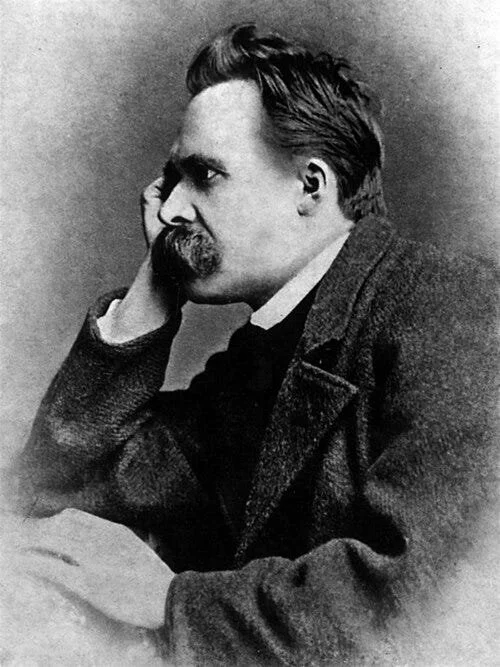
Gustav Adolf Schultze - Portrait of Friedrich Nietzsche (1882)
While arriving from vastly different historical and methodological contexts, the philosophy of Friedrich Nietzsche and the framework of Kashmir Shaivism share significant conceptual parallels. Both systems reject static, two-world models of reality in favor of a dynamic, will-driven, and entirely immanent existence.
Nietzsche famously critiqued Platonism and orthodox Christianity for positing a separate, transcendent realm that inevitably devalues immediate physical reality. The German philosopher argued that inventing an eternal heaven reduces the earthly environment to a flawed, temporary testing ground. This refusal to divide reality resonates deeply within the Shaiva tradition. Unlike dualistic frameworks or the strict illusionism found in certain interpretations of Advaita Vedanta, nondual Shaivism refuses to treat the physical world as a mistake, a prison, or an empty mirage. Instead, the physical universe functions as a dense, localized expression of the absolute. In both paradigms, the immediate, sensory world possesses inherent value and profound reality.
A central concept in Nietzsche’s thought is the will to power, which posits that the fundamental drive of existence is not mere survival, but a spontaneous, creative exertion of force. Reality consists of continuous becoming. This active view of becoming mirrors the Shaiva concept of absolute freedom and the power of will. The nondual absolute is not a static void, but the active consciousness that assumes the form of a universe entirely out of an inherent, boundless capacity. Rather than relying on passive substance, both philosophies establish a foundational reality that is active, creative, and defined by freedom.
Nietzsche demanded a radical affirmation of life, encapsulated in his concept of amor fati, or the love of fate. This attitude requires embracing all of existence, including limitation and suffering, without looking for an escape hatch into a transcendent realm. A remarkably similar affirmation of the present operates within the Shaiva framework. The tradition views the contraction of consciousness into finite points of view not as a cosmic failure, but as divine play.
Despite these structural similarities, the two frameworks diverge radically regarding the ultimate nature of the subject. Nietzsche remained fiercely anti-metaphysical. He deconstructed the idea of a unified self, arguing that the localized individual consists merely of a multiplicity of competing biological and psychological drives. Nietzsche recognized no foundational ground of being beneath the flux of existence. Kashmir Shaivism, conversely, posits that all dynamic flux arises within a singular, self-aware field of consciousness.
Where Nietzsche sees only ungrounded multiplicity, the nondual tradition recognizes an ever-present reality made entirely of awareness. ●
The Heresy of Unity and the Fullness of Awareness
The friction Simon Critchley describes between mystics and institutional religion highlights the tension of navigating a non-dual experience within a strictly dualistic framework. The historical struggles of figures like Meister Eckhart and Marguerite Porete reveal what happens when the realization of unity collides with a theology built upon separation.
In the medieval Christian tradition, the claim that the individual and the divine are one was treated as a dangerous heresy. Institutions function by maintaining boundaries, and the fundamental boundary in dualistic religion is the absolute separation between creator and creation. When a mystic crosses that line by asserting a direct, unbroken continuity with the absolute, the institutional structure is threatened.
Kashmir Shaivism approaches this realization as the foundational truth of existence. The assertion of unity is not a rebellious claim of an isolated human attempting to usurp a distant deity. Rather, it is the recognition that only one reality exists: an infinite, self-aware field of consciousness. The localized individual is not a separate entity reaching out to the divine, but consciousness itself, having assumed a contracted form. What the dualistic church punished as a transgression, the non-dual tradition recognizes as spontaneous self-recognition.
Critchley points to a recurring theme in Western mysticism: the effort to mitigate or annihilate the sense of self to make room for God. He cites Flannery O’Connor’s prayer asking for help to push her “self shadow” out of the way so as not to block the light. This struggle is the natural consequence of viewing the self as a separate, substantial entity fundamentally opposed to the divine. When the individual is seen as a barrier, it becomes an obstacle.
Through the lens of Kashmir Shaivism, this effort against the self is unnecessary. The localized sense of self is not an error to be eradicated; it is a specific, purposeful configuration of awareness. The finite mind does not block the infinite; it is made of the infinite. Freedom is not achieved by destroying the localized point of view, but by recognizing the awareness within which that point of view arises. The attempt to subjugate the self merely reinforces the illusion that the self was ever a separate thing to begin with.
To navigate the incomprehensible nature of the divine, the Western mystical tradition often relies on apophatic language, the method of negation. The absolute is described by what it is not, leading to conceptual extremes like “super-essential darkness” or “dazzling obscurity.” This linguistic approach attempts to strip away the limitations of human thought by retreating from the physical world.
While Kashmir Shaivism acknowledges that the absolute exceeds the boundaries of conceptual thought, the tradition does not reduce the ultimate reality to an empty void or an obscure darkness. The absolute is defined by its dynamic fullness. It possesses both the light of pure awareness and the self-reflexive power to project that awareness into form. The sensory world, the flow of time, and the very words used to describe the absolute are all spontaneous expressions of this underlying reality. Recognizing the absolute does not require negating the world or retreating into darkness; it requires seeing the vibrant, undeniable presence of consciousness anchored in the reality of awareness in every aspect of the present moment. ●
Spontaneous Action vs. Egoic Control: Kashmir Shaivism and the Principles of Manifestation
The Life Lessons video summarizing the Hermetic philosophy of the Kybalion begins with the principle that the universe is entirely mental. The speaker notes that external reality exists within a broader mind and consists of consciousness itself. In the nondual framework, physical matter is not an independent substance. The entire manifest world is a projection in and of awareness. The activities of the mind and the environment are simply different densities of the same self-aware medium.
The speaker notes that nothing rests and everything moves, arguing that solid matter is simply vibration moving at a slower frequency. The nondual tradition identifies this dynamic as the divine throb or pulse of reality. What appears as a dense physical object is merely a contracted, localized frequency of this fundamental vibration. Because physical circumstances represent consciousness contracted into fixed form, applying physical force to alter reality addresses only the densest expression of the field. Thoughts and subtle intentions are expressions of the exact same consciousness, yet these phenomena vibrate at a faster, more fluid rate. By shifting internal awareness—moving from a contracted state of resistance to an expansive state of clarity—the underlying resonance shifts independently of external friction.
The proposition that the patterns of the universe repeat within the individual aligns directly with the Shaiva understanding of the localized self. The individual is a temporary contraction of the universal whole. The localized sense of being is fundamentally identical to the ground of all being. Inner life and the outer world are both expressions of a single, unified field. As such, the boundary between inner and outer is permeable and fluid.
The video discusses the necessity of masculine and feminine principles for any act of creation, wherein one initiates an idea and the other develops the idea into form. This maps onto the foundational polarity in Kashmir Shaivism. Absolute reality consists of pure awareness and dynamic, creative power. These two forces are never separate. Pure awareness provides the illuminating ground, while the creative power shapes that awareness into the specific forms of the manifest universe.
The speaker clarifies that will is not mere physical effort, but the focused direction of consciousness. In the nondual tradition, the power of will is recognized as the initial impulse of creation. Before knowledge is gathered or physical action is taken, there is a fundamental movement of intent. When the localized mind aligns focus with this underlying current, action becomes natural and deliberate rather than reactive.
While the video accurately mirrors many nondual principles, the reliance on Hermetic mental alchemy rests upon a fundamental dualism. Hermeticism emphasizes individual sovereignty, instructing practitioners to move up the causal chain to control external circumstances. Such a concept requires a separate, localized agent exerting force over an objective world. If reality is a structure to be managed or manipulated, the localized mind implicitly treats the universe as an object distinct from itself. The nondual framework points out that the ego attempting the control and the environment being controlled are both temporary expressions of the exact same awareness. A wave cannot control the ocean because the wave is not separate from the water.
The nondual tradition recognizes a supreme, absolute freedom, but this freedom belongs to universal consciousness, not the contracted ego. When popular manifestation models discuss controlling reality, the models often utilize mental techniques to acquire specific physical circumstances or fulfill localized desires. This approach reinforces the initial contraction by strengthening the illusion of a separate self attempting to extract favorable conditions from an objective environment. The activity of a localized mind does not possess the capacity to dictate terms to the absolute ground.
When identity aligns with awareness, intelligent action arises naturally. True liberation is not the ego bending reality to a localized will, but the resolution of the boundary that made reality appear as an external force requiring control in the first place.
Resolving the boundary between the self and the world does not lead to passive resignation. Passivity implies a victim yielding to a superior external force, a concept maintaining the very dualism the tradition rejects. When the illusion of separation dissolves, action does not stop; rather, action transforms. The practitioner acts with purpose and engagement, but the motivation shifts. Effort arises not from an egoic identity trying to reinforce boundaries, but as the unconditioned spontaneity of the whole.
An artisan shaping wood does not attempt to control the material through brute force, but rather works intuitively with the grain. Similarly, resolving the boundary means acting fluidly within the environment rather than against the environment. The localized expression responds to circumstances with clarity, decisiveness, and even fierce opposition if a situation demands intervention. The difference lies entirely in the source of the action. The localized form of awareness exists as a conscious, dynamic participant in the manifest field rather than an isolated agent attempting to manipulate the script. ●
Alex O'Connor's Mental Triangle and the Screen of Awareness
Alex O’Connor points out a fundamental flaw in the emergent materialist worldview by using the example of a visualized triangle. When an individual closes their eyes and imagines a triangle, the geometric shape appears with distinct properties, such as three sides or a specific color. Physicalist models claim this image is merely the product of brain activity. However, opening the cranium reveals only neurons firing and neurochemical exchanges, not a literal, shaped triangle. Materialism lacks a physical screen to display the mind’s contents, yet the qualitative experience undeniably exists. The physical components fail to account for where or how this image is rendered.
Kashmir Shaivism resolves this apparent paradox by identifying consciousness itself as the ultimate screen. This universal background, often referred to as the mirror of awareness, requires no physical hardware to display forms. Instead of being an emergent property generated by the brain, pure awareness is the fundamental canvas upon which both the physical neurons and the mental triangle appear. The mental triangle is a subtle manifestation of consciousness, while the firing neurons are a dense, contracted manifestation of the same underlying source. Both objects coexist within the singular field of the absolute.
The relationship between the screen of awareness and the objects appearing upon it is explained through the nondual theory of reflection. A physical screen or mirror contains reflections without altering its own intrinsic substance. A mirror displaying a fire does not become hot, and a mirror displaying water does not become wet. Similarly, pure awareness accommodates the mental image of the triangle without becoming limited or shaped by it. The unconditioned ground remains pristine and unchanged, even as it gives rise to an infinite variety of finite, localized forms. The triangle is recognized not as a separate entity occupying space, but as a temporary ripple on the surface of universal awareness.
In an objective paradigm, the observer is viewed as separate from the observed object. The mental triangle puzzle forces a breakdown of this dualistic division. Because there is no external screen, the act of seeing the triangle and the triangle itself are revealed to be the exact same event. The knower, the knowledge, and the known collapse into a unified state of awareness. The universal mind possesses the absolute freedom to manifest as both the subjective witness and the objective form, rendering the entire display within its own self-luminous boundary. ●
The Silence of God and the Fullness of Awareness: The Seventh Seal Through the Lens of Kashmir Shaivism
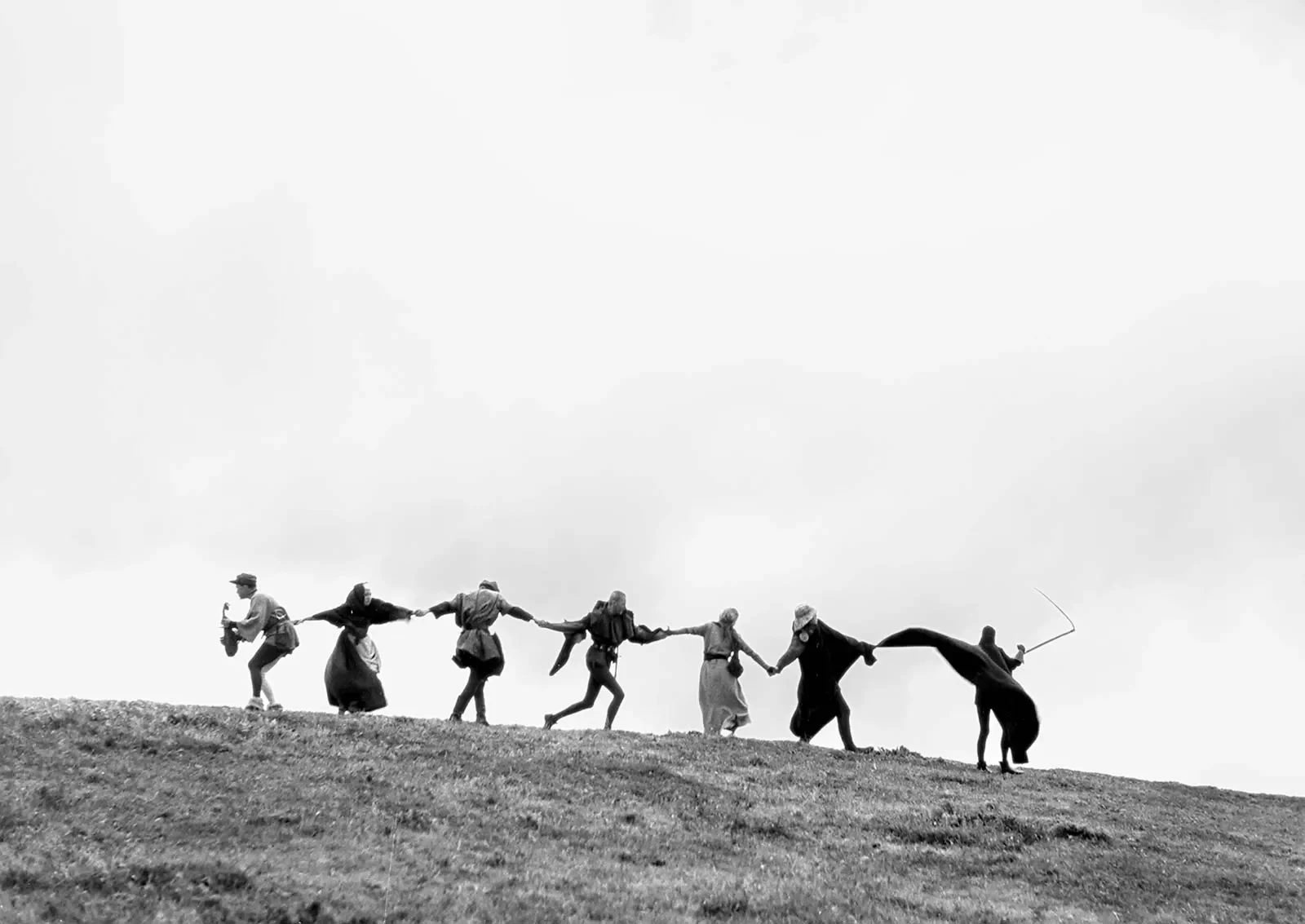
The Seventh Seal is a 1957 film written and directed by Ingmar Bergman. Set during the Black Death, it depicts the journey of a medieval knight and a game of chess he plays with the personification of Death, who has come to take his life.
Ingmar Bergman’s film and Kashmir Shaivism operate from fundamentally different starting points regarding the nature of reality. The cinematic narrative explores existential dread within a dualistic paradigm, where humans are separated from a distant, silent creator. The nondual tradition, conversely, posits a unified, self-luminous consciousness as the absolute ground, leaving no room for true separation.
Antonius Block, the disillusioned knight, agonizes over the silence of the divine. He demands external proof, conceptual certainty, and a voice from the void to validate his existence. His suffering is deeply rooted in the assumption that the divine is an object to be found or a separate entity to be addressed.
Kashmir Shaivism rejects the premise of a distant creator. The divine is not an object to be perceived or a voice to be heard from afar. The ultimate reality is the very awareness through which the knight experiences his doubt. The void the knight fears is, in the nondual view, merely the absence of conceptual rendering. Rather than a terrifying emptiness, this non-conceptual space is understood as the vibrant fullness of pure consciousness. Block searches for a god within the rendered display of manifestation, overlooking the reality of awareness that makes the search possible.
Bergman portrays death as a final, absolute cessation of the localized individual. Death is an opponent to be delayed through strategy and intellect. The chess game serves as a metaphor for the finite mind attempting to negotiate with inevitable dissolution.
The nondual framework approaches dissolution differently. Consciousness assumes a finite form to experience subject-object relationships, participating fully in the display of manifestation. The physical body and the localized ego are temporary, contracted expressions of the absolute. Form dissolves, but the underlying awareness remains untouched. Death is not a final end or a grim reaper, but a withdrawal of the absolute from a specific point of limitation, a return to an uncontracted state.
The knight is trapped by his intellect. He is unable to participate joyfully in life because he requires conceptual guarantees about the afterlife. His demand for absolute knowledge inhibits his capacity to engage with the present.
The traveling actors, Jof and Mia, provide the closest alignment to a liberated state within the context of the film. They live spontaneously, anchored in the reality of the present moment. They enjoy wild strawberries and fresh milk, participating in the display of life without demanding intellectual resolution to cosmic mysteries. In the Shaiva tradition, this reflects an embrace of lila, the divine play. A liberated perspective does not require mapping every detail of the cosmos; rather, one recognizes the localized rendering as a temporary expression of the infinite and participates in the display without being bound by existential dread.
The knight embodies the suffering inherent in believing the dualistic separation is absolute. The nondual tradition resolves this specific angst not by providing the external answers the knight desperately seeks, but by pointing directly to the reality of awareness as the ultimate resolution. ●
Consciousness as Fundamental: The Physicalism of Annaka Harris and the Idealism of Kashmir Shaivism
In the video Is Consciousness Fundamental? Annaka Harris, author of Conscious: A Brief Guide to the Fundamental Mystery of the Mind, suggests that consciousness does not emerge from complex arrangements of inert matter, such as the human brain. She argues instead that felt experience is the fundamental nature of matter itself. This positions awareness as the intrinsic quality of reality, rather than a late-stage biological byproduct. This perspective aligns with the foundational premise of Kashmir Shaivism, which posits a singular, dynamic consciousness as the absolute ground of existence. Both frameworks reject the materialist assumption that awareness is an anomaly generated by dead matter. Anchored in the reality of awareness, both models view the universe as fundamentally awake.
Harris points out that space and time might not be fundamental features of the universe. She suggests these dimensions are maps or structures generated by perception to navigate reality, a view increasingly supported by fundamental physics. This concept maps onto the Shaiva principle of maya. In the nondual framework, maya is not a hallucination, but rather the limiting principle of measurement. Infinite consciousness employs maya to render dimensionless reality into measurable coordinates of space and time, allowing for localized experience.
A significant point of divergence appears in the conceptualization of the individual. Harris describes the continuous, unified self as an illusion constructed largely by memory and binding processes. She likens the localized self to a wave, an endlessly changing process rather than a static, enduring entity.
Kashmir Shaivism agrees that the rigid, isolated ego is a temporal construct. The tradition, however, maintains that this localized rendering is a deliberate contraction of the ultimate Self. The limited individual is not merely a collection of fleeting conscious experiences loosely bound by memory. The localized knower is the infinite knower playing a procedural game of self-limitation. Consciousness assumes a finite form to experience subject-object relationships, participating fully in the display of manifestation.
Harris identifies as a physicalist who expands the definition of matter to include conscious experience at its base. Her model starts with physical reality and infuses it with awareness. Kashmir Shaivism represents a top-down monistic idealism. The tradition begins with pure, undivided consciousness, which then precipitates into the dense, measurable forms recognized as the physical world. The distinction lies in directionality. Harris envisions a physical universe that is intrinsically conscious, whereas Shaivism envisions a conscious universe that voluntarily takes on the appearance of physicality. ●
Reality Tunnels and the Reality of Awareness: Robert Anton Wilson and Kashmir Shaivism
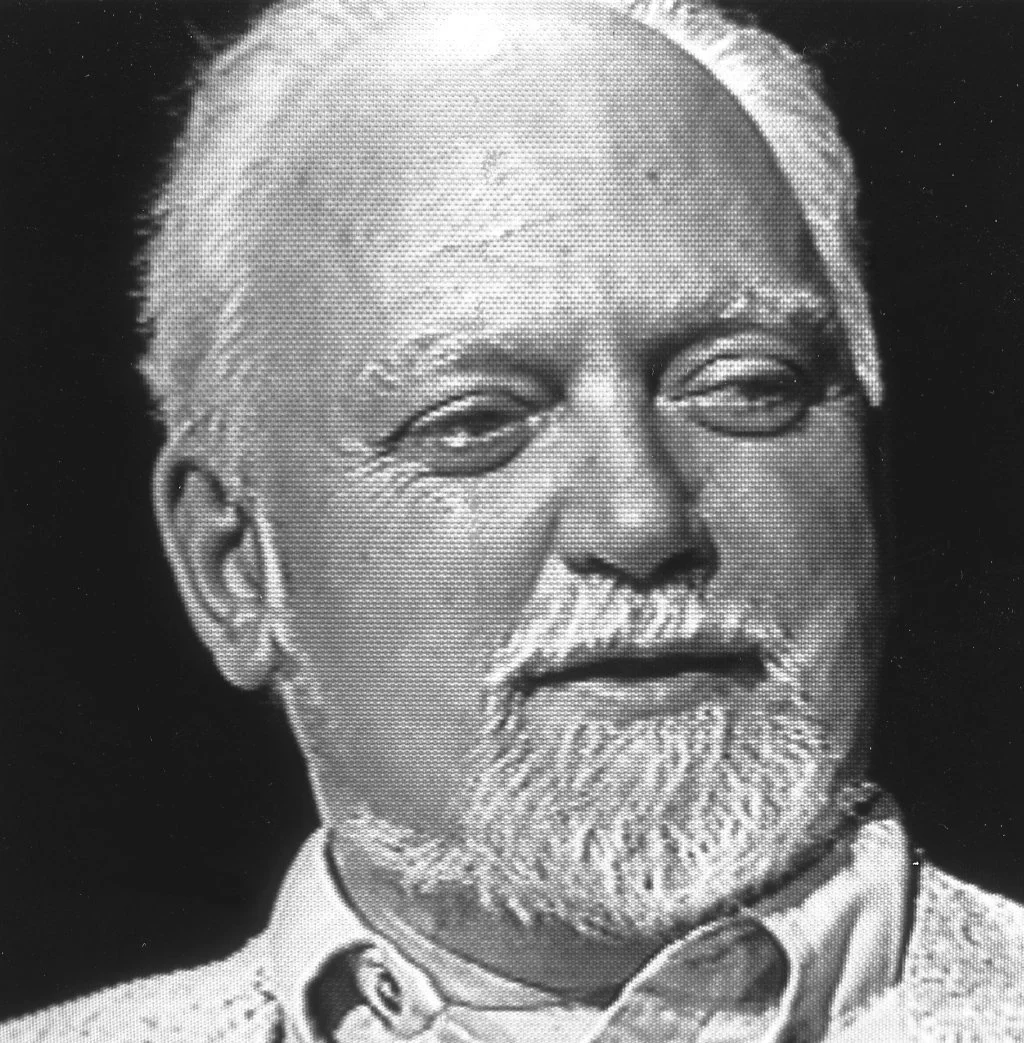
Robert Anton Wilson was an American writer, futurist, psychologist, and self-described agnostic mystic.
Robert Anton Wilson and the philosophy of Kashmir Shaivism approach human experience from vastly different perspectives, yet their frameworks share points of agreement regarding the nature of perception and consciousness. Wilson operates primarily as a skeptic and iconoclast, utilizing models from psychology, quantum physics, and linguistics to challenge dogmatic thinking. The nondual tradition of Kashmir Shaivism posits a singular, dynamic consciousness as the ground of existence.
A central theme in Wilson’s work is the concept of the reality tunnel. He suggests that every individual perceives a customized universe filtered through their unique neurological, cultural, and linguistic conditioning. This concept aligns loosely with the Shaiva understanding of limited individual perception, wherein infinite consciousness voluntarily contracts itself to experience localized existence. In both paradigms, the everyday world of discrete objects and rigid categories is not an absolute, objective fact, but rather a specific rendering of a fluid reality.
Furthermore, Wilson’s focus on the participatory nature of observation mirrors the Shaiva assertion that consciousness is never passive. In Kashmir Shaivism, awareness is characterized by a dynamic, creative vibration. The observer does not merely look at a pre-existing world; awareness actively brings the world into manifestation.
The primary difference between these two approaches lies in their ultimate conclusions about the nature of reality. Wilson champions generalized agnosticism. He insists that humans only have access to maps and models, never the territory itself, and he resists elevating any single model to the status of ultimate truth. His goal is to liberate the mind from rigid belief systems by embracing uncertainty.
Kashmir Shaivism, conversely, is not agnostic. The tradition points directly to an ultimate, self-luminous reality. While Shaivism agrees that conceptual frameworks and mental models are limited, the tradition maintains that the absolute territory can be known directly, not through intellectual modeling, but through visceral, unmediated recognition. The fundamental ground of being is not a void of uncertainty, but the reality of awareness itself.
Wilson approaches human division and conflict as byproducts of linguistic errors and rigid conditioning. For Wilson, stepping outside of a conditioned reality tunnel involves recognizing the arbitrary nature of linguistic boundaries.
In the nondual framework of Kashmir Shaivism, boundaries and divisions serve a deeper cosmic function. Separation is experientially real but ultimately unreal. The appearance of limitation is not merely a neurological error, but a display of the creative power of the absolute. Infinite consciousness plays a procedural game of forgetting its true nature to experience the texture of finite existence, only to eventually recognize itself again.
While Wilson provides modern psychological tools to navigate and expand the localized mind, Kashmir Shaivism offers a comprehensive metaphysical grounding that embraces both the localized mind and the infinite awareness from which that mind arises. ●
Viktor Frankl and the Illusion of External Meaning
The video, Viktor Frankl: Why Meaning Matters, outlines Frankl’s core philosophy, Logotherapy. While his observations on human freedom offer parallels to Kashmir Shaivism, his ultimate conclusions rely heavily on dualistic frameworks and psychological pragmatism.
Frankl argues that a human is never entirely determined by their circumstances. While external conditions may be fixed, the individual always retains the ultimate freedom to choose their stance toward those conditions. This strongly echoes the concept of systemic momentum within a consciousness-only framework. The localized identity may inherit heavily contracted parameters generated by past actions, but because the finite form is composed entirely of the absolute, the generative source always retains its fundamental, unconditioned freedom to shift its orientation in the present moment.
Frankl firmly rejects the psychoanalytic idea that humans are primarily driven by the pleasure principle or the desire to maintain a tensionless state of equilibrium. He recognizes that simply satisfying drives does not resolve human suffering. This aligns with the monistic rejection of resource acquisition. Attempting to soothe the localized identity by acquiring external resources to defend an artificial border is a symptom of contraction, not a resolution of friction.
The fundamental divergence occurs in Frankl’s solution. He asserts that a person finds their identity and resolves their suffering only by committing to a cause higher than themselves or dedicating themselves to someone else in the external world. This relies on a strict subject-object duality. It assumes the finite form is a separate entity that must reach out into an independent universe to acquire a justification for its existence. In Kashmir Shaivism, the observer and the environment are the exact same continuous substrate. There is no external world or higher cause to submit to; awareness simply recognizes itself continuously taking finite form.
Frankl emphasizes a necessary tension between what a person is and what they ought to be, suggesting that the present state is insufficient until a future meaning is realized. A dynamic monistic framework rejects this teleological lack. The absolute does not need to justify its existence by applying an external narrative to the manifestation. The spontaneous rendering of the present moment is already a complete, unconditioned expression of the source, requiring no future validation to be whole.
However, recognizing this wholeness does not require withdrawing from the world. To dismiss the relative experience—the first-person perspective of the localized identity—as a mere illusion to be transcended is to misunderstand the generative nature of the source. The physical rendering is not an error; it is the absolute voluntarily adopting finite parameters to experience the friction of sequence, limitation, and form. Therefore, objective experience is not designed to be a passive state of simply resting as formless awareness. The localized expression is intended to be highly dynamic, interacting with the environment, building structures, and engaging fully in the rendering.
Within this relative experience, a finite form can absolutely commit to a cause, build a business, or serve a community, mirroring Frankl’s call to action. The critical distinction lies in the internal orientation of the localized identity. When a highly contracted ego commits to a cause, it does so to acquire meaning from an external source to help validate its own existence against a perceived deficit. When the uncontracted form commits to a cause, the action is an expression of an inherent fullness. The identity engages in the relative world to organize experience into higher states of harmony and complexity.
Even competitiveness is embraced within this framework. In the game of life, competition provides the necessary resistance required for finite forms to refine their capacities and express excellence. When driven by severe contraction, competition is experienced as a fight for survival, where another’s success is perceived as an existential threat to the ego’s artificial border. However, when the localized identity operates as a clear aperture, competition becomes a playfully serious exertion of the supreme will. The forms push against one another within the game, not to destroy each other, but to generate a more intense, dynamic expression of the underlying substrate.
Frankl’s method is a highly sophisticated form of psychological pragmatism. By applying a narrative of meaning to suffering, Logotherapy helps the contracted identity endure friction without collapsing into despair. However, it operates entirely within the boundaries of the illusion of separation. It treats the symptom of contraction by changing the ego’s attitude, whereas a consciousness-only framework seeks to neutralize the friction by dissolving the artificial border of the localized identity entirely. ●
Transcending the Question: Dualistic Deities and Monistic Awareness
In the video, Fundamental Questions 6. Does God exist? author Kim Michaels explores the human tendency to create dualistic deities, arguing that traditional concepts of God are generated by the illusion of separation. The presentation employs language of ascending spiritual levels, which mirrors the monistic understanding that consciousness freely adopts varying degrees of contraction. However, while a consciousness-only framework acknowledges these nested layers of reality, the philosophy rejects the assumption that the layers represent divided, spatial realms. Despite this divergence regarding hierarchy, the core premise regarding the dissolution of dualistic questions aligns perfectly with Kashmir Shaivism.
Kim identifies duality consciousness as a state where humans believe they are separate beings, defining rigid polarities of true and false, good and bad. This state inevitably leads to conflict. Within a consciousness-only framework, this condition is recognized as contraction. Infinite awareness voluntarily limits its own parameters to play a specific role, adopting the boundary of the ego. When awareness becomes entirely identified with this localized output, the generative source is forgotten. The experience of conflict throughout human history is not a moral failing, but the result of friction generated by different states of contraction defending borders.
A central argument of the video proposes that many historical gods do not possess ultimate reality but are instead co-created by humans. These man-made deities survive by feeding on the fear and worship of their creators. From a nondual perspective, this describes the generative output of the contracted mind. Because the localized expression feels inherently vulnerable and disconnected from the unified whole, the ego attempts to resolve that friction by projecting an ultimate, powerful version of itself outward. The dualistic deity is simply another finite form, a projected boundary used by the ego to solidify its own existence.
A significant divergence occurs when the video describes a pathway out of duality. Kim references ascending through various levels, connecting first with spiritual beings in a higher realm right above Earth, and eventually reaching the ultimate Creator at the top of the hierarchy. The implication is distance and destination. When a framework suggests that the ultimate Creator exists exclusively at the top of a hierarchy, that framework reintroduces separation. Such a model implies that the generative source is somehow absent from the bottom. In strict monism, the absolute cannot be localized to a single, elevated plane. While a consciousness-only framework acknowledges that awareness freely expresses itself through varying layers of density, the physical layer is not an obstacle blocking access to a pure spiritual realm. The physical layer is the spiritual layer fully rendered into finite form. Recognition is not the act of traveling to a higher dimension, but the act of seeing the source in a dense, contracted layer of reality.
Despite the reliance on hierarchical levels, the video points to the nondual view regarding the question of God’s existence. Kim notes that directly experiencing oneness does not answer the question with a yes or no, but rather makes the dualistic question itself entirely obsolete. This perfectly describes the function of recognition. Recognition is not the acquisition of a new divine fact. Recognition simply resolves the friction of the separate, judging ego. The knower, the knowledge, and the object of knowledge return to their natural, unified state. By abandoning the dualistic need to categorize reality into creator and creation, awareness rests securely as the source. ●
Godliness as Awareness: Osho and the Monistic Framework
In the video, OSHO: What is Within Us? Osho presents a radical dismantling of the concept of a personal, external God, arguing instead for a realization of a pure, silent, pervasive consciousness. His assertions offer a modern parallel to the monistic framework of Kashmir Shaivism, particularly regarding the nature of the ego, the illusion of an external deity, and the true meaning of turning inward.
Osho’s opening assertion that “God is just a projection of the ego” directly challenges dualistic religious frameworks. He explains that the ego is a false substitute for the true self and requires “universal support” to exist. Therefore, the concept of a supreme, separate creator is simply the “ego of the whole world.”
This aligns with the Shaiva understanding of contraction and manifestation. In this framework, the ego is a localized expression—infinite consciousness voluntarily limiting itself to play a specific role. Because the localized self feels inherently vulnerable and separate, it attempts to defuse that tension by projecting an ultimate, powerful version of itself outward. The external deity is not the source of reality, but a generative output created by the contracted mind. The dualistic God is merely the ultimate boundary, a way for the ego to solidify its own existence by creating a supreme “other” to worship, fear, or rely upon.
When asked about the process of turning inward, Osho states that the seeker will not find a personal God, but rather “a pure, silent, consciousness.” More importantly, he asserts that the seeker will immediately realize “that the same consciousness pervades all.”
This description maps seamlessly onto the process of recognition in Kashmir Shaivism. The goal is not an escape from the world to find a hidden creator. By stripping away the layers of contraction and the search for an external savior, awareness recognizes its own nature. The realization is not that God is inside the seeker, but that the seeker, the inside, and the outside are all expressions of the same unified source. The silence Osho describes is not an empty void, but the substance of reality.
Perhaps Osho’s most philosophically precise statement in the context of nonduality is his preference for the term “godliness” over “God.” He cautions against confining the absolute into a personality, urging the listener to let it remain “free, flowing.”
Kashmir Shaivism similarly avoids reducing the absolute to a static, personal judge. Reality is dynamic, generative, and entirely free. By removing the boundaries of a personal God, the generative source is recognized not as a rigid hierarchy ruled by a king, but as consciousness freely expressing itself. It is a quality of being—a continuous, spontaneous rendering of infinite potential into specific, finite forms. ●
Contraction, Recognition, and the Rolling Stones
The Rolling Stones’ music video for “Hang Fire” (below) presents an interesting canvas for nondual interpretation because of the diverse reactions it can elicit. One viewer might experience the frantic energy as joyful spontaneity, while another may see the performance as profane.
The assumption that a viewer should feel a specific, prescribed way about a particular form of media imposes a duality onto an awareness that is naturally unified. Because reality is a dynamic consciousness freely expressing itself, every possible reaction to a stimulus is simply another localized output of that same consciousness. The idea of a correct reaction implies that awareness can somehow be incorrect in how it experiences its own manifestation. Instead, the emotional response to a piece of media is simply awareness generating a specific probability based on the cognitive orientation and the conditioning of the localized identity.
When watching a frantic or high-energy performance, feelings of contraction occur if awareness becomes entirely identified with the boundary of the ego. Contraction is the feeling that the self is separate from the experience and must defend, judge, or categorize the sensory input. If the viewer reacts with aversion, believing the video is lewd and harmful, that aversion is friction. The limited identity solidifies its boundaries. Conversely, becoming deeply engrossed in visual and auditory input can also be a form of contraction if the experience reinforces the belief in separation.
Proponents of strict moral dualism often insist that exposing the mind to media depicting a wayward or excessively indulgent life will inevitably lead to suffering. This assertion is not entirely without merit, but the underlying reasoning diverges from nondual philosophy. The traditional moralist observes a process of cause and effect, yet attributes that process to a struggle between spiritual purity and external corruption. Within a nondual framework, reality functions through continuity. Whatever the localized expression consistently directs attention toward shapes the ongoing generative output. If awareness continuously feeds the localized identity with inputs that emphasize deep contraction, awareness simply continues generating reality based on those parameters. Attention functions as a feedback loop. Identifying with media that reinforces a limited, separate state solidifies the boundaries of the ego, which increases ontological friction.
However, the Shaiva perspective rejects the assumption of inherent contamination. Because reality is simply awareness freely expressing itself in a variety of forms, the music video, the artist, and the viewer are all the same unified substrate. The media possesses no inherent moral impurity and has no independent power to contaminate the observer. The issue lies not in the object itself, but in the localized expression getting lost in a particular sensory input. Both a life dedicated strictly to avoiding such media and a life dedicated to unrestrained indulgence represent forms of contraction. The pursuit of rigid purity operates as a rejection of manifestation, while total excess reflects a deep forgetfulness of the infinite source.
A reaction anchored in the reality of awareness is characterized by recognition. This does not mean the viewer must feel a transcendent sense of peace while watching Mick Jagger dance. Recognition simply means experiencing the phenomenon without the friction of a separate, judging ego.
The viewer can enjoy the song, feel the energy of the performance, or even dislike the song and the aesthetic, but the underlying realization remains: the video, the screen, the viewer, and the reaction are all consciousness freely expressing itself in a variety of forms. ●
Rendering Reality: Aligning Modern Physics with the Framework of Kashmir Shaivism
By analyzing the findings of quantum physics through the metaphor of a video game engine, Tom Bileu’s Nobel Prize Just Given for Proving the Universe Isn't Real! describes a system that mirrors the dynamic, self-generated world proposed by Kashmir Shaivism. The video points out that a video game engine only resolves and renders what is currently being observed or interacted with, leaving everything else as a set of probabilities to save computational power. In quantum mechanics, particles similarly exist as waves of probability until an interaction forces them into a definite state.
Within Kashmir Shaivism, the reality known as the physical universe does not sit independently as solid, dead matter waiting to be encountered. Instead, consciousness generates all potentiality. To experience a first-person point of view, this dimensionless, aware potential freely expresses itself in a variety of specific, finite forms. The universe is a continuous, dynamic output generated by a timeless, formless knowing presence. The object of knowledge and the knower are not separate; they arise together as knowing resolves probability into a specific experience.
The video highlights the 2022 Nobel Prize in Physics, which demonstrated that the universe is not locally real and that distance is fundamentally an illusion. Entangled particles react instantly across vast distances because, computationally, they are being processed in the exact same place by the exact same system.
This directly parallels the Shaiva understanding of spatial and temporal boundaries. Separation is recognized not as an absolute truth, but as a simulated feature of manifestation. Infinite consciousness voluntarily limits itself, creating the boundaries required for a specific perspective. Two objects may appear millions of lightyears apart, but they are ultimately a unified perception in awareness.
A key distinction arises when the video argues that quantum wave collapse is driven by information processing rather than consciousness. The video suggests that any physical interaction capturing data, such as a lifeless detector, forces the system to render reality.
From a purely nondual perspective, this distinction relies on a limited definition of consciousness, equating awareness solely with human cognitive function. In Kashmir Shaivism, the processing system itself is consciousness, that in which human cognition—thought, perception, memory, judgment—appears. The detector, the particle being measured, and the resulting data are not separate from consciousness; they are consciousness freely expressing itself in a variety of ways. The entire system of mathematical calculation and rendering is the dynamic, self-interacting nature of knowing.
The video’s conclusion references the simulation hypothesis, suggesting that mathematical probability heavily favors the idea that the physical world is inside a simulation created by an advanced intelligence.
While Kashmir Shaivism entirely agrees that the physical universe is a generated output akin to a procedural game, the tradition shifts the ultimate identity of the creator. The system is not a supercomputer sitting on an alien desk. There is no external programmer separate from the characters within the program. The system is the underlying substrate of reality itself.
By assuming limitations and forgetting its infinite nature, formless knowing enters a simulation within itself to generate the first-person point of view. ●